


What Slice Serum actually is
A standard eye patch is a piece cut in advance and stored in serum. A Slice Serum product works the other way round: the formula is a solid hydrogel block inside a cylindrical jar. You twist the base, a blade shaves a thin slice off the face of the block, and that slice is the patch.
Nothing is pre-cut. Nothing sits in liquid. The texture is firm and slightly tacky rather than wet, so it does not drip on the way to the face and it stays put once applied.
That change in how the product is stored and dispensed is the whole idea - and it is why the format photographs so well, which matters more than it sounds.
Why it is on every brand's radar right now
This format had a very visible 2026, and the sequence is the best proof that retail demand is real:
|
Date (2026) |
What launched |
|
July |
Wonder Bath (Korea) releases "Slice Serum" eye patches - the earliest commercial version |
|
17 September |
Fenty Skin launches Dew N Plump Fresh-Sliced Hydrogel Eye Patches |
|
18–20 September |
Glow Recipe reveals Exopeptide Caffeine Brightening and Depuffing Fresh Slices Eye Mask |
|
22 September |
Huda Beauty's Undereye Jelly Patches appear in the same twist-and-dispense jar |
|
Late September |
The format goes viral across beauty media and social platforms |
Four brands, one quarter, one mechanism. Whatever else that says, it says the format sells - and it says consumers already understand it, which is a considerable advantage for a brand launching in 2027. You are not educating the market from zero.
What this means for your 2027 line
Position it as the hero, not the replacement. Slice Serum is a premium, high-attention SKU. It earns its place above your existing pouch and jar lines, not instead of them.
Pick the active that carries your story. The three most requested right now are PDRN, bakuchiol and collagen. Each one comes with an audience that is already searching for it, which shortens the distance between your launch post and a sale.
Treat the jar colour as brand identity. On a shelf, and in a fifteen-second video, colour is the thing people remember. Pink, yellow, blue and purple are the four that move fastest; a specified shade is also possible when the palette needs to be exact.
Slice Serum compared with pouch and jar
The three formats do different jobs. Most brands we work with run more than one, and there is no reason to choose only one.
|
Sachet (pouch) |
Jar (tub) |
Slice Serum |
|
|
Format |
One pair sealed per sachet |
Multiple patches stacked in a tub |
Solid block in a twist jar |
|
Cost per use |
Highest - packaging per use |
Lowest - large pack, cost spread thin |
Mid - jar amortised across 60 slices |
|
Tooling and MOQ |
Lowest barrier, no mould needed |
Low, standard tub |
Needs a mould, higher MOQ |
|
Taking one out |
Tear and apply - cleanest |
Fingers or a spatula |
One twist, never touches the patch |
|
Travelling |
Pack what you need |
Bulky, can leak |
Compact cylinder, no liquid |
|
Serum payload |
High |
High |
Moderate - the block must stay firm |
|
Where it wins |
Trial, travel, gifting, single-dose premium |
Everyday value, large pack, family use |
Launch buzz, social content, gift sets, premium tier |
A common structure is to run all three: a sachet for trial and travel, a jar as the volume driver, and Slice Serum as the launch story. Senwell produces all three, so a brand can build the full ladder without splitting the account across suppliers.
The material: hydrogel
Slice Serum is built on hydrogel - a water-based polymer matrix rather than a silicone film or a solvent carrier. That is what gives it the cool, cushiony feel and the close contact under the eye.
It is also why the format fits so many brand philosophies. Hydrogel is the usual platform for products that are positioned as vegan, cruelty-free and built on biodegradable polymer systems. Those are properties of the material class and of how the formula is built, and they are the reason this format reads as modern rather than as another mask - which is exactly the association a 2027 launch is looking for.
What you can customise
|
Item |
Options |
Notes |
|
Jar colour |
Pink, yellow, blue, purple - or a specified shade |
The strongest shelf signal; one colour per SKU |
|
Patch colour |
Pink, yellow, purple |
Usually matched to the hero active |
|
Hero active |
PDRN, bakuchiol, collagen |
Also available: caffeine, niacinamide, peptide |
|
Sheets per pack |
30 or 60 |
60 is the market norm; 30 suits trial and gifting |
|
Decoration |
Screen print or label |
Logo on the jar body or the cap |
|
Formula direction |
Fragrance-free, no artificial colour |
Set per market requirement |
Colour and active are usually decided together, because the two carry the same message. A pink jar with a peptide story, a purple jar with PDRN, a yellow jar with a brightening active - that pairing is what a buyer understands in one glance.
What clients actually remember
Two messages arrived two days apart in October 2026, from buyers working on different projects.

26 October 2026 - "I contacted 3 or 4 suppliers and you have been the MOST helpful."
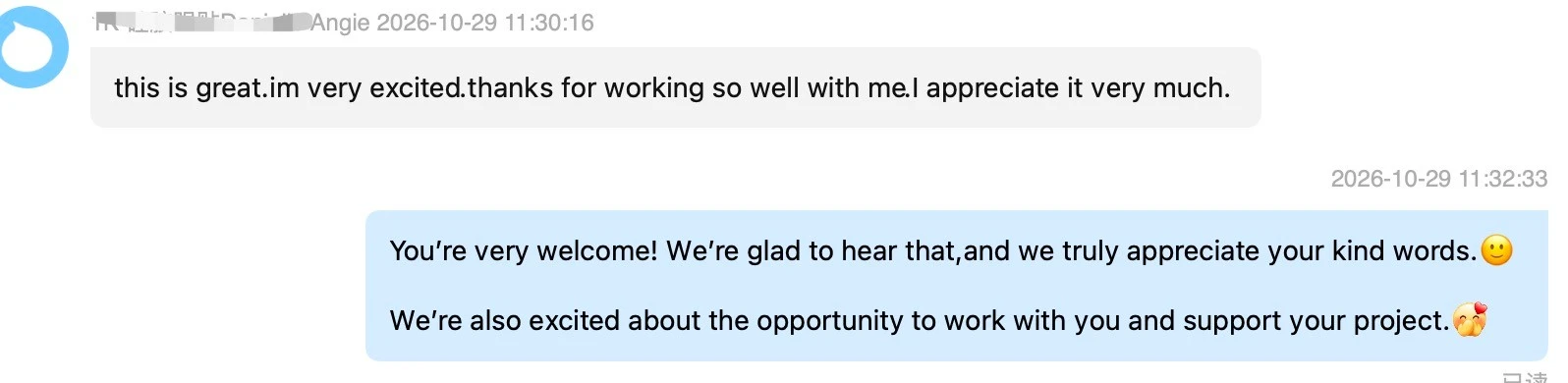
29 October 2026 - "This is great. I'm very excited. Thanks for working so well with me."
Neither message is about a patch. They are about how the project felt to work on - and that is precisely what a new format tests. A first run of a format nobody in your team has launched before generates a long list of small questions: does the slice hold its shape at this thickness, does this colour read the same on a matte jar, will this active stay stable in a solid block, can the logo sit here instead of there.
The supplier who answers those quickly is the one whose name comes up when a buyer compares notes. It is also, practically, the one whose launch date does not slip.
FAQ
Is the patch wet when it comes out of the jar?
No. The block is a solid hydrogel and the slice comes off as a firm, slightly tacky sheet. That is why it does not drip and why it works for a quick application before makeup.
Is every slice fresh?
Yes - each one is cut from the block at the moment you twist, rather than being pre-cut and stored. That is the practical difference from a tub.
Can the jar colour match our branding?
Yes. Pink, yellow, blue and purple are the four standard options, and a specified shade can be matched when the brand palette requires it.
Which active should we choose?
PDRN, bakuchiol and collagen are the three with the strongest current demand. The right choice is the one that matches the audience you already have, not the one with the loudest trend.
How many sheets should a pack hold?
60 is the market norm and the better value story. 30 works well for trial, gifting and travel retail.
Can we launch this alongside our existing pouch and jar lines?
Yes, and most brands do. The three formats serve different purchase occasions, and running them together builds a fuller shelf presence than replacing one with another.